Collective Worship
The importance of collective worship
The Church of England guidance document Inclusive, Invitational and Inspirational, sets out the expectations for Collective worship in Church schools. It aims to ensure that worship remains relevant and an essential component of an education that enables all pupils to flourish and ‘live life in all its fullness’ (John 10:10).
Faithful implementation of this guidance supports the development of meaningful, high-quality relationships across faiths, worldviews, cultures and beliefs, and helps pupils learn to advocate for one another, challenging discrimination and promoting equality.
At Almondsbury, Collective worship enables the Christian vision of the school to be explored, shared and reflected upon, placing biblical teaching at the heart of the school. It provides a space for pupils’ Spiritual, Moral, Social and Cultural development, where they can discover different ways of expressing their own spirituality and worship.
At Almondbury CE Primary School, collective worship:
• Reflects the Anglican status of the school, through a rich, diverse and lived Christian tradition.
• Provides pupils with a rich experience and understanding of Christianity.
• Offers an encounter with Jesus Christ and with Christian faith and practice in a way that enhances pupils’ lives.
• Offers prayer, and opportunities to read and reflect on the Bible, liturgy, sacrament and experience of the musical and other imaginative riches of Christianity.
• Provides space for pupils’ spiritual, moral, social and cultural development, where they can discover different ways of expressing their own spirituality and worship.
• Is Inclusive: Worship is collective in that it involves meeting, exploring, questioning, and responding to others and, for some, to God.
• Is Invitational: Pupils and adults can expect to encounter worship that is consistently invitational.
• Is Inspiring: Pupils and adults can expect the worship they encounter in a Church school to be inspirational.
This form of encounter through worship should be truly welcoming, inclusive and exemplifies the principles of Christian hospitality. This is an approach that seeks to meet the needs of all, wherever they may be on their journey of faith and belief. The legal framework for collective worship. The responsibility for collective worship lies with the governing board, in consultation with the headteacher, who must ensure provision meets legal requirements. Each Church of England school, whether VA, VC, or academy, must provide collective worship in accordance with the beliefs and practices of the Church of England. It is important to distinguish between the statutory guidance for schools without a religious foundation, which require collective worship to be wholly or mainly of a broadly Christian character, and the expectation for Church of England schools to provide a daily act of collective worship that is rooted in the beliefs and practices of the Church of England. This reflects the Anglican status of the school, in line with its trust deed. This is offered to every pupil, every day (except in the case of withdrawal).
The right of withdrawal
Parents have been able to withdraw their children from collective worship since the 1944 Education Act and no recent legislation has affected this right. It is most recently confirmed in Section 71 of the School Standards and Framework Act 1998.
The government guidance document which remains current in the case of collective worship is Circular 1/94: Religious Education and Collective Worship. A Church school has a legal duty to provide collective worship in accordance with its trust deed, for every pupil every day. However, no current legislation affects the parents’ rights to withdraw their children from collective worship if they wish to do so. This includes withdrawal from attending collective worship in church. If the parent asks that a pupil should be wholly or partly excused from attending collective worship at the school or church, then the school must comply.
Procedures for withdrawal
The school has a clear policy and written procedures for handling a withdrawal request or parental complaint about collective worship which complies with the law. Clear procedures for both are set out within the school’s Collective Worship Policy.
In order not to place an ‘undue burden’ on parents , requests for withdrawal should be granted without question since parents/ pupils are not required to give a reason to exercise the right to withdraw. We make the ability to withdraw simple and easy to follow without requiring justification or meetings to occur.
If appropriate, we may wish to gather information from parents who have exercised their right to withdraw in order to understand any particular concerns about the collective worship provided within the school for evaluation purposes. However, we will take not to stigmatise or burden the parents in any way. When dealing with a withdrawal, we will describe to the parents what alternative arrangements will be made for your child. We may offer a conversation for clarity or pastoral support, providing this is optional and not a condition of the withdrawal consent. This may provide an opportunity to explore how the child’s withdrawal can be best accommodated. For example, it may be possible for the school to include withdrawn pupils in celebration events, if they can easily be included in the non-religious elements of these events. Again, care will be taken not to stigmatise or burden the pupils in any way. For prospective parents, it is important to explain as clearly as possible what the arrangements for collective worship in the school are and how this relates to the Christian character of the school.
Almondsbury CE Primary School Prayer
Our School Prayer
God be in my head and in my understanding,
God be in my eyes and in my looking,
God be in my mouth and in my speaking,
God be in my heart and in my thinking.
Amen.
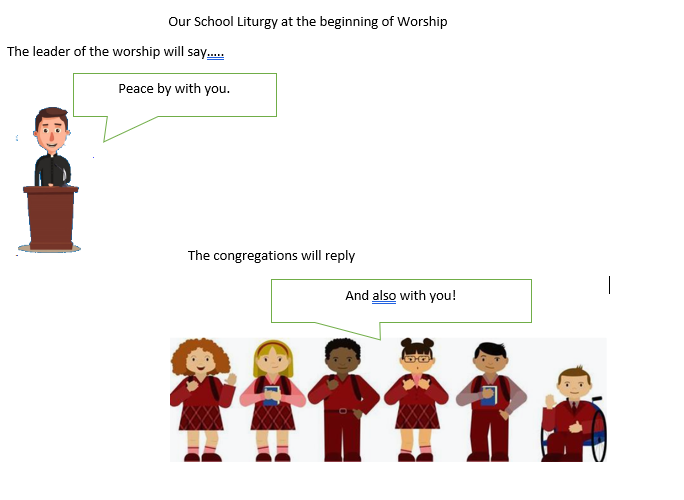
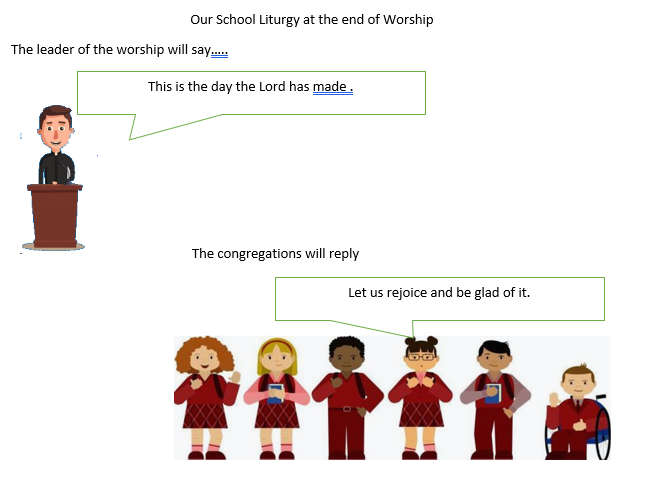
Almondsbury CE Primary School Liturgy