
Science
Science – Curriculum Intent
At Almondsbury Primary School we recognise the importance of Science in developing our pupils’ knowledge and understanding of the world around them. We encourage our children to develop their natural curiosity about the world through weekly discrete Science lessons. These provide the children with a rich and meaningful insight into many different areas of Science where they can deepen their knowledge and understanding.
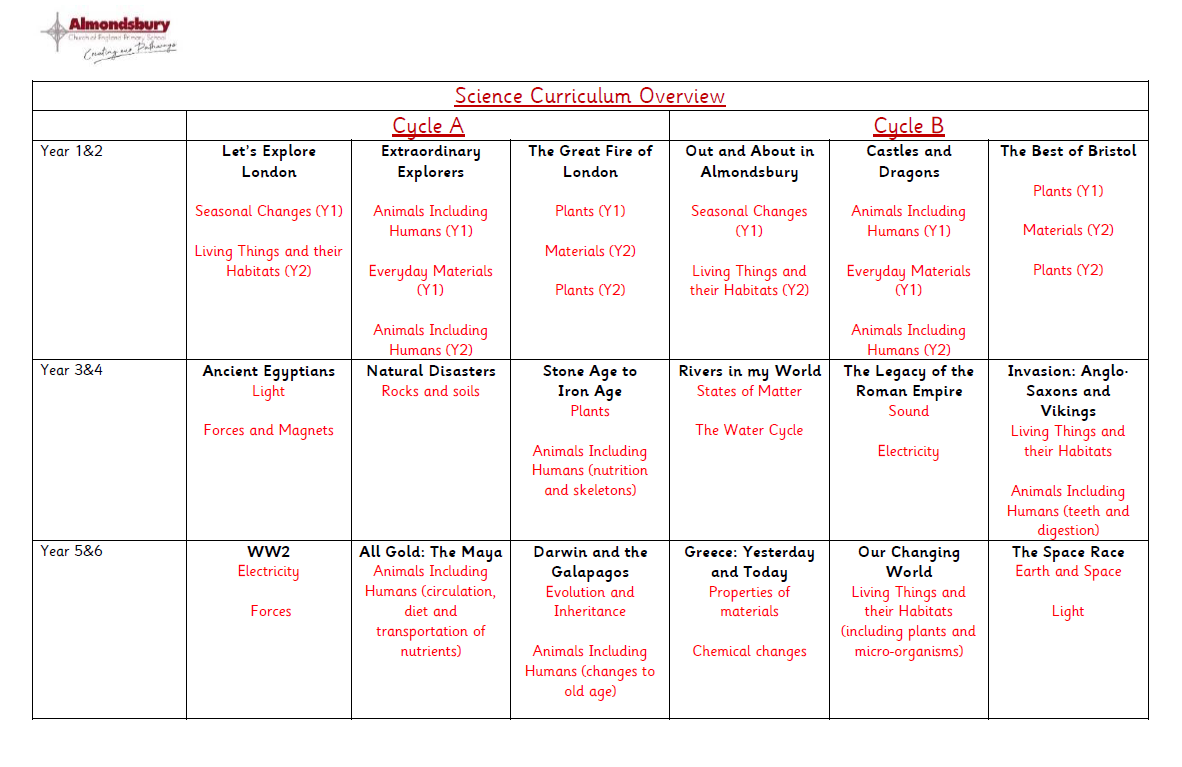
Our Science curriculum covers a range of topics which fall under the three main scientific disciplines of biology, chemistry and physics. Within the biological strand, children learn about the processes and functions of the human body as well as developing their understanding of plants and animals. This is built upon as children progress through the school to ensure detailed coverage and progression. The chemistry and physics units, which cover a broad spectrum of topics including space, forces, states of matter, light and electricity amongst others, are taught within specific year groups, and serve to broaden pupil’s scientific knowledge base as they progress through the school. All science units combine a balance of substantive and disciplinary knowledge to ensure that children leave Almondsbury with the right skills to be successful scientists. By ensuring that the teaching of scientific knowledge is progressive across year groups and phases, pupils connect together a rich body of knowledge and develop schema, which help them to know and remember more.
Alongside the development of scientific knowledge and skills, we place a strong emphasis on the progressive teaching of subject-specific vocabulary. We aim for all children at Almondsbury to develop the confidence to understand, recall and use scientific terminology accurately and appropriately. Key vocabulary is explicitly taught, revisited and built upon across year groups and key stages, enabling pupils to articulate their scientific understanding, make meaningful connections between concepts and reason scientifically.
We believe that children should also develop their ability to think scientifically and develop their understanding of enquiry and investigation. Therefore, within our topics we provide the children with lots of opportunities to perform hands-on practical investigations as a way of answering insightful scientific questions. Enquiry skills are mapped across the curriculum with the five areas of enquiry (observing over time; pattern seeking; identifying, classifying and grouping; comparative and fair testing; researching using secondary sources) sequenced throughout each key phase.
To help scaffold consistent and detailed investigations we have developed an investigation proforma which is visible in every class and is built upon as children move through the school. These break down scientific investigations into three key areas of investigative skills (planning, obtaining evidence and evaluation), allowing the pupils to understand the different requirements to ensure reliability and validity.
The scientific proforma includes:
- Question – What am I trying to find out?
- Prediction – What do I think will happen?
- Equipment – What will I need to perform the investigation?
- Fair Test – How will I ensure the investigation is fair?
- Method – What steps will I take when performing the investigation?
- Results – How can I measure what has happened?
- Conclusion - What have I learnt from this? Was my prediction correct?
We believe that our approach will help the children to be equipped with the scientific knowledge required to understand the uses and implications of science, today and for the future, enabling them to develop knowledge that lasts a lifetime.
The national curriculum for science aims to ensure that all pupils:
- Develop scientific knowledge and understanding through the specific disciplines of biology, chemistry and physics.
- Develop understanding of the nature, processes and methods of science through different types of science enquiries that help them to answer scientific questions about the world around them.
- Are equipped with the scientific knowledge required to understand the uses and implications of science, today and for the future.